The costs of systematising a hobby
I like systems. More specifically, I like using systems to manage what I do, how I allocate time, and how I get things done.
Two years ago, I started a system for reading. Like a lot of people, I was bemoaning the fact that I used to read a lot, and now didn't read very much. I owned a Kindle, but by this point was using it quite infrequently. I had an Audible subscription, but wasn't really using my one credit a month. In both cases, I was using them just when I felt like it - when the urge to do so took me, at whatever time during downtime.
From the start of 2024, I began a slightly more regimented system. I would maintain queues in Trello for both Kindle/physical books in one, and audiobooks in another, so that there was always a next book waiting when one was completed, and a place to put recommendations. I would use these to capture thoughts as I read them. And crucially, I implemented a target of twenty minutes per day of reading (actually a ten day moving average of twenty minutes).
This turned out to be one of the most successful systems I've ever set up. In both 2024 and 2025 I read about 40 books. I feel like I capture thoughts from books better, and I get to feel like a reader again. But the trade-off of imposing a minimum floor of time spent, is that you seem to also get a maximum ceiling that wasn't there before.
To ensure the 20 minutes gets done, I often add it into my daily to-do lists - 'spend 25 minutes reading' or 'read one chapter'. This ensures I do it, but it also unexpectedly removes the possibility of doing more. There's nothing actually stopping me from doing it, but I have essentially converted reading into work, something I have to do, and once I've made the minimum, my brain seems to entirely rule out the possibility of doing more. The moment you define 'done' for a task, you create a natural stopping point that your brain treats as permission to disengage. The system that ensures you will read for 20 minutes is the same system that ensures you won't read for 90.
It might be argued that this is no different than before. Except, oddly, even though I read less before in aggregate, there was much greater variance in time spent reading in any one session. Sometimes I would just spend an hour reading. If I was only reading when I enjoyed doing so, there was no reason to stop once I got going. Now I read more, in tightly defined bursts, that feel like something I have to just get done.
The psychological relief of "I've done my reading" is what makes the habit sustainable. But that relief is also what kills the possibility of flow - you can't enter a flow state while simultaneously watching the clock for your exit cue.
Walking has shown a similar pattern. I always walked a lot, but I wanted to similarly systematise it so I added 'ten thousand steps' to the same moving average target system. The effect can be seen clearly in the graph of steps per day. I now consistently get just over 10k, but now rarely go on long meandering walks. High variance and unlimited ceiling have been replaced with low variance and guaranteed floor.
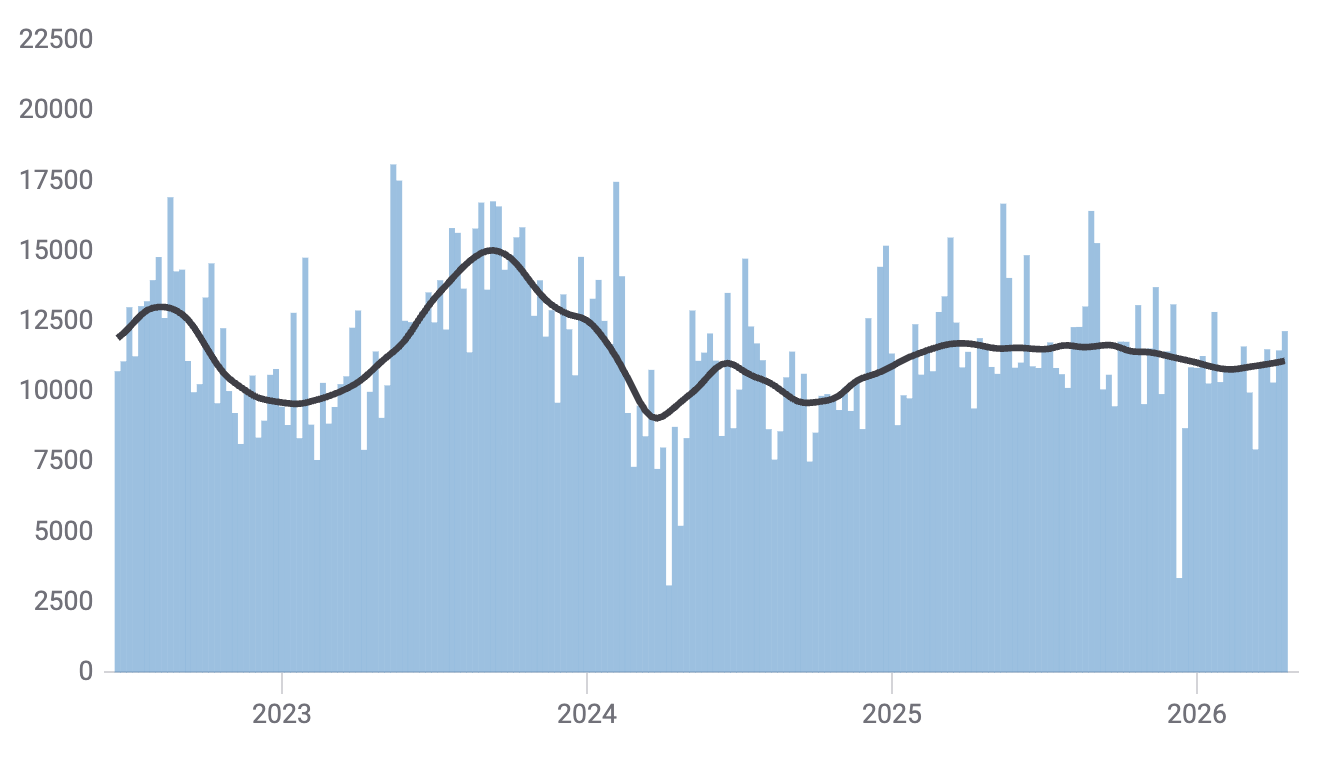
Average daily step count over the past few years, taken from lytiko.
I am nevertheless still quite happy with the system, and don't want to return to the old haphazard approach. It is important to me that I read a lot.
But still, it is a reminder to decide what you want to optimise for. Do you want to optimise for how enjoyable reading is, for the average duration of a reading session, or the volume of reading? Is there a way to optimise for the latter while keeping the former? Or is the price of systematising everything always going to be that it makes a previously spontaneous pursuit sterile?
I don't really know yet. I hope not.